
What Order Should You Decorate a House In?

Get the order wrong and you repaint a wall you already finished. Or you protect a new floor from work that should have happened first. There is a right order, and two rooms break it on purpose.
This page sets out the full sequence for decorating a house. It covers the one stage people most often get backwards. It also covers the two mistakes that cost the most to fix.
- What’s the full sequence, start to finish?
- Should decorating happen before or after new flooring?
- What are the two costliest ordering mistakes?
Call 0191 743 3614 today if you’d rather have your sequence checked than guess.
The Full Sequence: What Order to Decorate a House In
One rule governs most of this: dirty-to-clean, top-to-bottom.
Work that creates dust or debris happens first, before any painting starts. Once decorating starts, each stage runs from the ceiling down. Dust and drips land on the stage below, not the one already finished.
| Stage | What Happens | Why It Comes Here |
|---|---|---|
| Structural work and first fix | Any wall or ceiling changes, plus first-fix plumbing and electrics | Cuts, chases and cable runs make mess that decorating would only have to cover twice |
| Plastering | New or repaired plaster goes on, then gets time to dry properly | Paint on wet plaster blows and cracks — the first of the two costly mistakes below |
| Ceilings | Mist coat on any new plaster, then two finish coats | Ceilings go first so drips or splashes land on walls still to be painted |
| Walls | Mist coat if needed, then the main wall colour | Same top-to-bottom logic — walls sit above the woodwork and the floor |
| Woodwork prep and undercoat | Filling, sanding and priming skirting, doors and frames | Prepared and primed before the final coat, so nothing needs redoing later |
| New flooring | Hard flooring goes down and gets protected immediately | The one genuinely disputed stage — covered in full below |
| Woodwork top coat | The final coat on skirting, doors and frames | Goes on once the floor beneath it is down and protected |
| Kitchen and bathroom fit | Units, tiling and fittings go in | The other rule-breaker — covered in full below |
| Snagging and final touch-ups | Marks from moving furniture and fittings back get touched in | The last stage, once everything else is back in the room |
Two stages break this simple order on purpose: new flooring, and the kitchen and bathroom fit. Both get their own section below, because both depend on the job in front of you.
Once decorating finishes, moving furniture back in has its own timing. See our page on moving furniture back after painting.
Get My Free Quote
Get your own house sequenced properly before you start.
Decorating Before or After New Flooring?
This is the one stage that depends on your situation. It comes down to two things: the flooring type, and how easy it is to protect.
As a rule, hard flooring goes down before the final coat on the skirting. That covers wood, tile and engineered board. Fitting it creates dust and knocks, and it needs to settle before woodwork gets its last coat.
Carpet is different. As a rule, it goes down last, once decorating wraps up. Fitters tuck it against a skirting that’s already painted, and it never has to sit through dust or drips.
The practical rule: get hard flooring down and settled before the last coat of woodwork paint. Save carpet for last, once decorating wraps up.
Full detail on how we prepare and finish skirting, doors and frames is on our wood painting page.
Where Do the Kitchen and Bathroom Fit In?
Kitchens and bathrooms don’t follow the simple top-to-bottom rule. Both have their own fitting trades: units, tiling and sanitaryware. All three need to slot in around the decorating, not after it.
The walls get a base coat before the units go in, so nobody is painting behind a fitted kitchen later. The final coat and any touch-ups happen after fitting. That’s once tiling has cured and new sockets or extractor fans are in place.
That order protects the finish. Paint goes down clean, and touch-ups fix any fitting marks before anyone moves back in.
Keeping the existing kitchen and just refreshing the cabinets, rather than refitting? See our kitchen cabinet painting page instead. The same applies to a bathroom suite that’s staying put — see bathroom painting.

Two Costly Ordering Mistakes
Two mistakes account for most of the expensive redos. Both come from skipping the drying time a stage needs.
Mistake One
Painting Before the Plaster Has Dried
New plaster needs real drying time before it takes paint. Decorate too soon and the finish blows or cracks. The whole coat then has to come off and go back on.
Mistake Two
Finishing the Floor Before the Decorating Is Done
Lay a new floor before painting is finished and it’s exposed to drips, dust and ladder marks for the rest of the job. Getting a mark out of a new floor is far harder than protecting it in the first place.
Both mistakes are avoidable with a sequence that’s followed, not just agreed at the start.
Get My Free Quote
Call before you start and dodge both mistakes.
Does the Order Change for an Occupied House?
Living in the house during the work changes the practical order, not the underlying rule. The dirty-to-clean, top-to-bottom logic still holds. What changes is how the job breaks into stages.
Instead of decorating the whole house in one pass, the work runs room by room. The rest of the house stays usable throughout. Kitchens and bathrooms only come out of use while work is under way there.
An empty house can run the whole sequence in one continuous pass. Nothing needs to stay usable along the way.
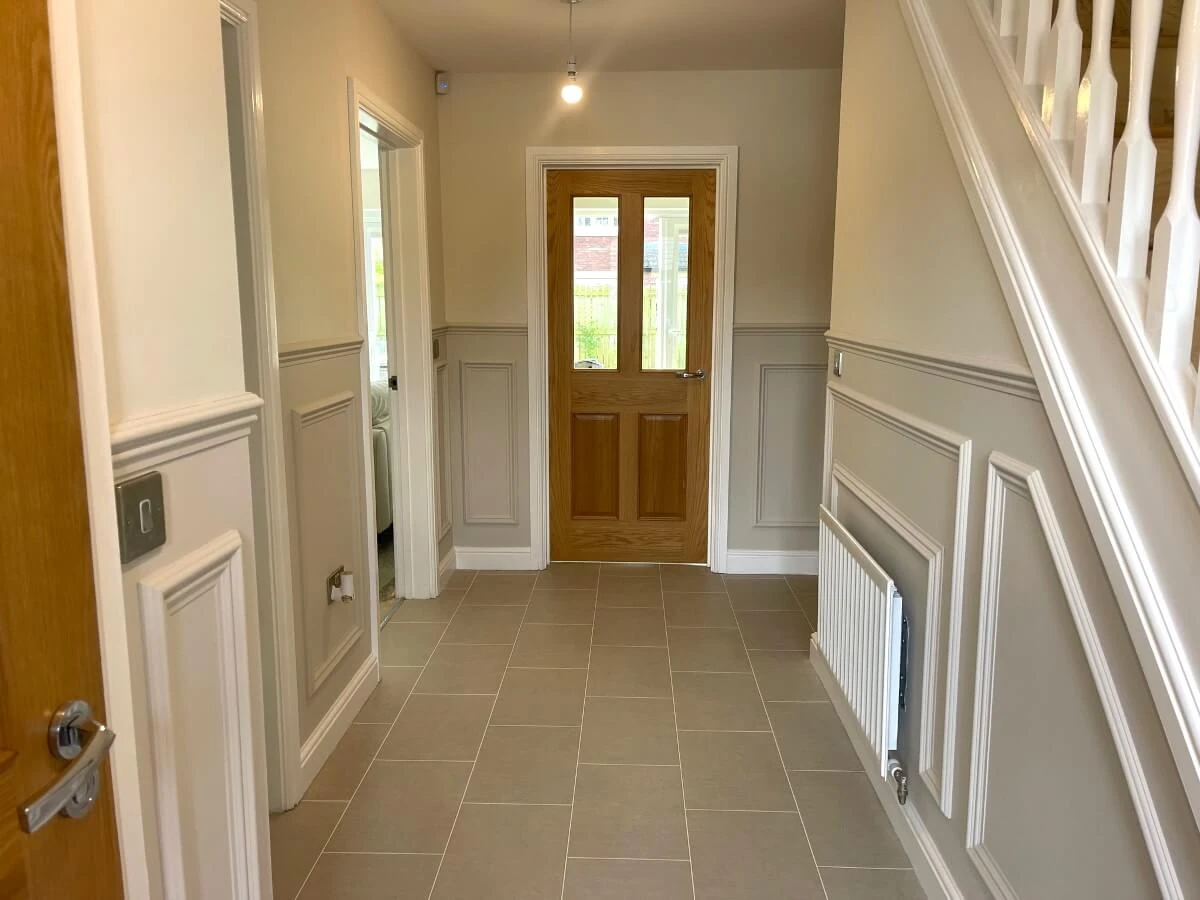
Full detail on decorating while living in the house is on our whole house decorating page. Working room by room applies just as well to a single hallway as it does to a whole house.
How Long Does Each Stage Take to Clear Before the Next One?
Each stage has to finish before the next one starts.
- New plaster: several days to two weeks before it’s ready for a mist coat, depending on how much went on
- Mist coat to finish coat: a few hours once the mist coat is properly dry, not just touch-dry
- Between coats of emulsion: four to six hours minimum, longer in a cold or damp room
- Woodwork undercoat to top coat: overnight, since undercoats need a full cure first
- Flooring to final woodwork coat: at least a day or two, so dust from fitting has settled
These are general ranges, not a fixed schedule for your own house. A survey is the only way to get real numbers for your rooms, your walls and your plaster.
For per-room and per-house timings, see our page on how long it takes to decorate a house.
Order-of-Work FAQs
Get My Free Quote
Fill in the form below for a free quote: