Rentals and licensed HMOs
Landlord and HMO Decorating in Newcastle upon Tyne

Managing a rental or a licensed HMO in Newcastle, and deciding what to repaint, how often, and in which paint?
Tulip Decor connects landlords across Newcastle upon Tyne with a local decorator. This guide covers how often to redecorate, the best paint for HMO walls room by room, and turning a whole HMO around between tenancies.
- How often does a rental need redecorating?
- What is the best paint for HMO walls?
- Can a whole HMO be turned around in the summer?
- What do fire doors and communal areas need?
- What does it cost, and what counts as deposit evidence?
Call 0191 743 3614 and talk through your rental or HMO.
How it works
How Tulip Decor Works
Tulip Decor connects Newcastle upon Tyne homeowners and landlords with a trusted local decorator. Tell us about the job and we’ll match you with the right decorator for your area, one we know and rate. We make the introduction and stay on hand. Your decorator does the work and stands behind it.
Your decorator asks about the bedroom count, whether it is a single let or a licensed HMO, and when the current tenancy ends. That is enough for a realistic idea of timing and scope before anyone visits.
A site visit follows for anything beyond a straightforward single-bedroom repaint, so the quote reflects the property’s real condition and access, not a guess made over the phone. Work is scheduled against your void period, not a generic availability list. That matters more for a rental than for an owner-occupied job.
How often
How Often Does a Rental Actually Need Redecorating?
Deciding when to repaint a rental is partly a budget question, and there is no fixed legal interval to go by. A standard assured shorthold tenancy requires a landlord to keep the property fit to live in. It does not set a repainting schedule.
In practice, a single let with a stable tenant can go five years or more between full repaints, especially when the original finish was durable.
A licensed HMO does not get that luxury. Higher turnover means more moves, more furniture knocks and more wear on the same walls in a shorter time. Bedrooms in a student HMO often need a refresh every one to two years. Communal areas need it more often: hallways, shared kitchens and shared bathrooms.
Rental walls also wear faster for a simple reason. Tenants rarely touch up marks at the end of a fixed term, and every change of tenant brings furniture dragged across the same skirting and pictures hung on the same wall.
Waiting until a wall looks tired costs more than staying ahead of it. Scuffed walls are a common flashpoint in a deposit dispute, and a property that is visibly behind on maintenance is harder to let at the rent you want.

Paint by room
What Is the Best Paint for HMO Walls, Room by Room?
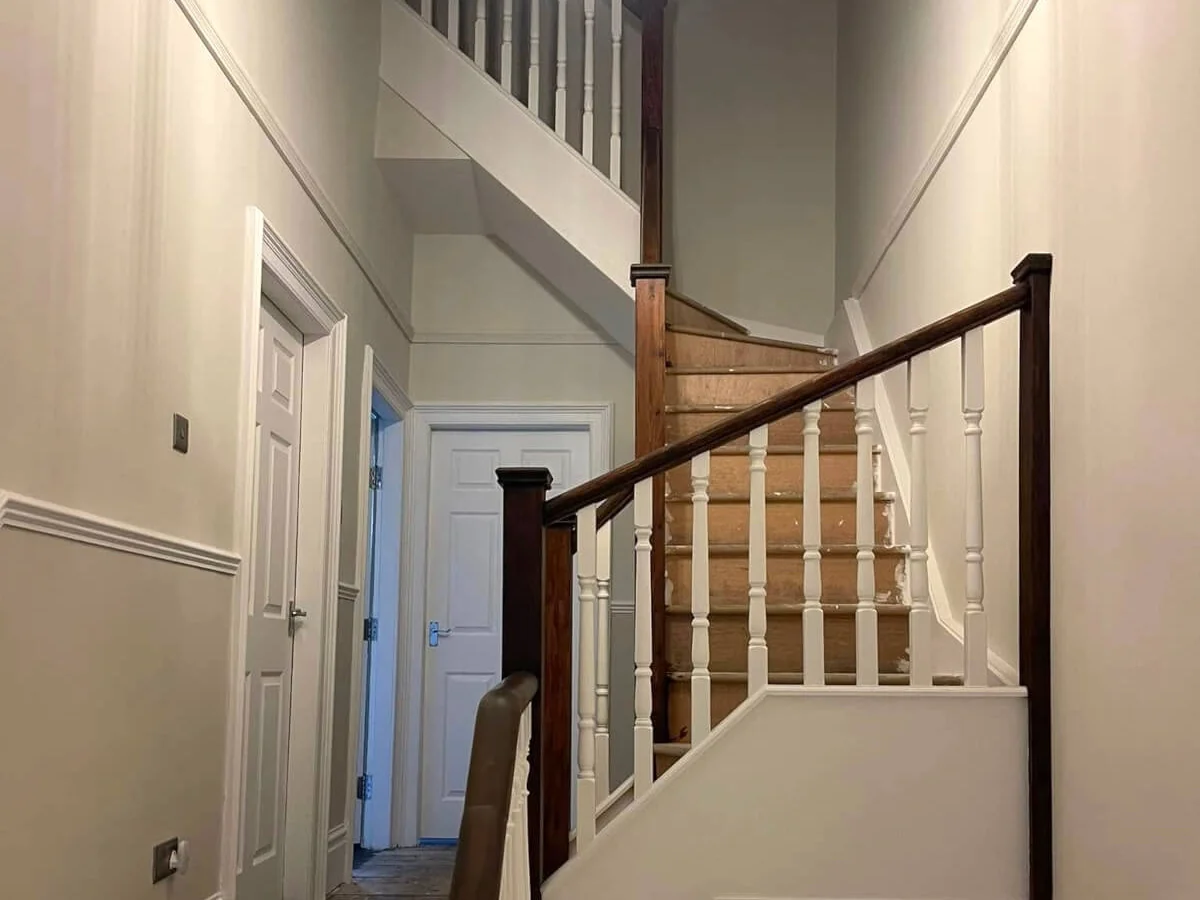
The best paint for HMO walls changes from room to room, so one answer for the whole property is usually the wrong one. Matt in a hallway is a false economy: it looks fine on the day the job finishes and shows every scuff within a month of tenants moving in.
Bedrooms and living rooms. These take everyday knocks, not constant traffic. A quality matt, a durable washable matt or a soft-sheen emulsion is normally enough. Scuffs here come more from furniture than from the paint, so you do not need to pay for the tougher finish that communal areas call for. For the full service on either room, see bedroom painting and living room painting.
Hallways, stairs and landings. These are the walls that schoolbags, bike handlebars and moving boxes hit, and communal areas take more traffic in a month than a bedroom takes in a year. Choose a washable, scrubbable finish, such as a mid-sheen emulsion or a trade-durable range built for repeated washing. Standard matt marks fast, and wiping it spreads the mark into the paint. Hallways and stairs are also the first thing every prospective tenant sees. See hallway painting for the full spec on stairs, landings and communal hallways.
Kitchens & bathrooms
What Paint Suits Kitchens and Bathrooms in a Rental?
Moisture is the variable that bedrooms do not have. Kitchens and bathrooms face steam, condensation and, in an HMO, several tenants’ cooking and washing habits in the same room. Grease and cleaning products shorten the life of a standard finish quickly.
Standard emulsion is not built for that. It can blister or flake over time, and mould often grows around extractor fans and splashbacks, where condensation settles first.
Use a washable, moisture-resistant, anti-mould emulsion or eggshell. It holds its colour and sheen through far more scrubbing than standard matt.
Ventilation still matters more than paint. The best anti-mould finish will not fix a bathroom with no working extractor fan, so check the ventilation as well as the spec.
For cabinet refreshes alongside the walls, see kitchen cabinet painting. For bathroom walls, see bathroom painting.

Five-year cost
Is Cheap Paint Cheaper Over Five Years?
A landlord comparing paint is really comparing how many repaints each one leads to. Cheap contract matt costs less on the day you buy it. It also marks faster and wipes down worse, so you are pushed towards a full repaint at the end of nearly every tenancy.
| Cheap contract matt | Durable washable finish | |
|---|---|---|
| Marks and scuffs | Show quickly, and stay | Wipe off with a cloth in most cases |
| Between-tenancy clean | Rarely enough on its own | Often enough on its own |
| Typical repaint trigger | Most changes of tenant | Visible wear, not just a change of tenant |
Price the cheap tin against three repaints over five years, not one, and it loses to the durable finish’s higher price per litre. The saving was never in the paint. It is in how often you have to buy more of it. Spec once, properly, and repaint less often.
Summer turnaround
Can a Whole HMO Be Turned Around Between Tenancies in the Summer?

A student HMO’s changeover window is short, and every landlord with a similar property is trying to book decorating into the same few weeks. The void period is the real constraint, not the paint. The window usually runs a matter of weeks between one tenancy ending and the next starting.
A whole HMO, with communal areas as well as bedrooms, is a bigger job than most single lets: more rooms, more prep in high-traffic areas and sometimes fire doors as well as walls. It is achievable inside a summer void, but only with a fixed start date agreed well ahead, not a call placed once the tenants have already left.
Last-minute jobs are the ones that run into trouble. Access, materials and scheduling all get compressed into days instead of weeks. Confirming a date as soon as you know your changeover window protects the turnaround more than any speed the paint itself can add.
Book Your Changeover Window
Get a start date in before the summer rush.
Fire doors
What Do Communal Areas and Fire Doors Need in a Licensed HMO?
A licensed HMO adds a compliance layer that a single let does not have, and fire doors are the part that is easy to get wrong without knowing it.
A fire door’s rating depends on an intact, properly specified coating system, not just any paint that happens to match the walls around it. Standard emulsion or gloss over a fire door can compromise its rating, and fire doors are a legal requirement in a licensed HMO, not a design choice.
Fire-rated paint and intumescent systems are built to keep that rating through repainting. They are specified differently to the walls either side of the door. Your decorator specifies fire-rated systems where needed on licensed HMO work in Newcastle upon Tyne.
Communal areas take a different kind of wear from a bedroom. Every tenant uses the hallways, shared kitchens, stairwells and shared bathrooms, so a finish that is fine in a bedroom often looks tired within months there.

Cost
What Does It Cost Per Bedroom to Redecorate an HMO in Newcastle?
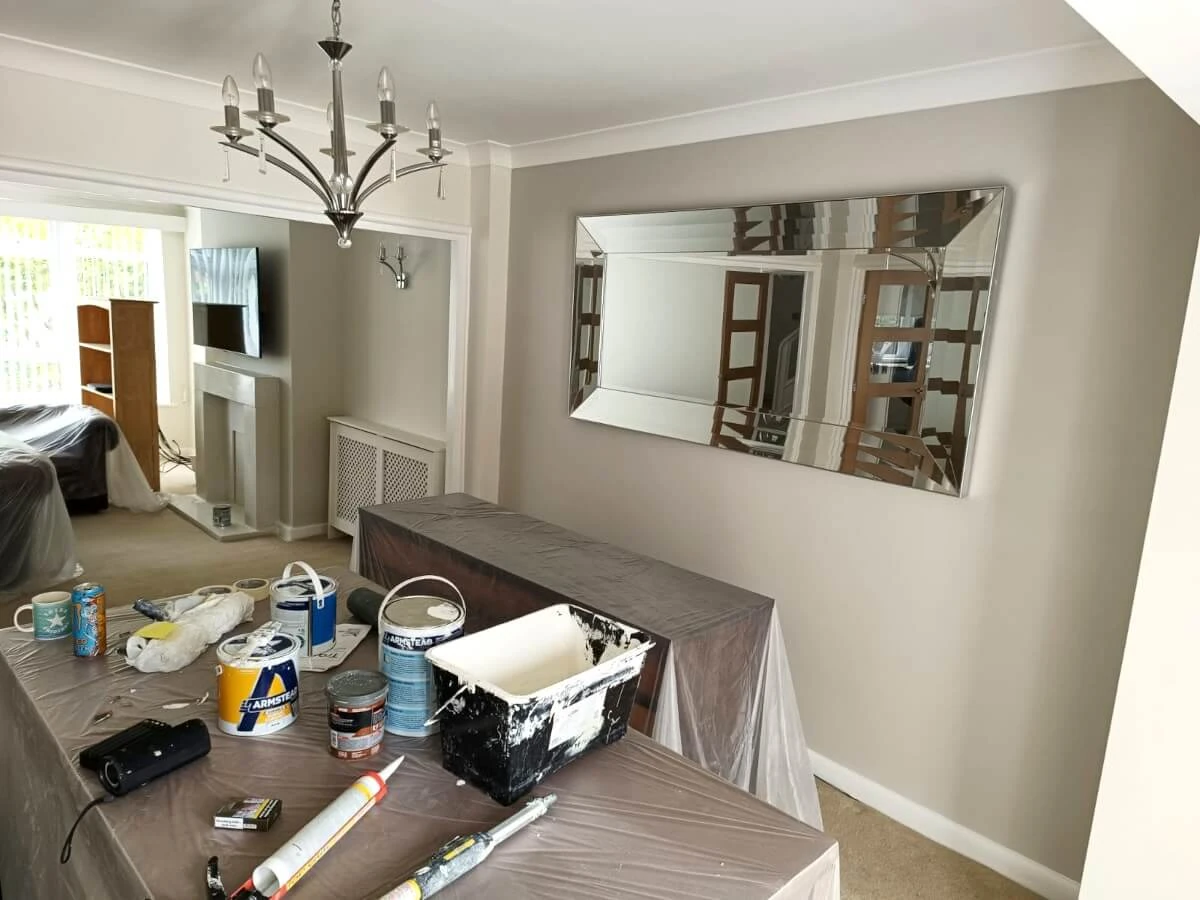
The honest answer is that it depends on room count, condition and access, so no single per-bedroom figure holds across every HMO in the city. Three things move the price most.
- How many bedrooms in one visit. One team working through a whole property costs less per room than five separate call-outs.
- How much prep each room needs. A few scuffs touched up costs far less than filling, sanding and a stain-blocking primer.
- Whether communal areas are included. Hallways, kitchens, shared bathrooms and fire doors often take longer to prep than a single bedroom.
A single bedroom refresh in reasonable condition sits at the lower end of what a room typically costs to decorate. A full HMO turnaround, with communal areas and fire doors included, is a bigger job again. It is priced like a whole-house repaint, by what is being done, not a flat number per door.
No figure is published here, because it would mislead for at least some of the HMOs it claimed to describe. A free survey turns room count and condition into a real number for your property. Comparing quotes? Our page on hiring a painter and decorator covers what a proper quote should include.
Deposit evidence
What Counts as Decent Evidence in a Deposit Dispute?
Deposit disputes are won on paper, not memory. Whoever settles one wants the condition of the property recorded at both ends of the tenancy, not recalled afterwards. Three things carry real weight.
Dated photos. Take them at check-in and check-out, room by room, in decent light. A photo with no date is far weaker than one clearly timestamped against the tenancy dates.
Itemised invoices. A single lump-sum invoice for redecoration proves less than one that breaks out rooms, surfaces and materials, because it shows exactly what was needed.
A written condition note from whoever did the work. A decorator’s note on the walls’ actual state before work started, beyond normal wear or genuinely just tired paint, carries more weight than a landlord’s own assessment. It comes from someone with no stake in the outcome.
None of this replaces legal advice on a specific dispute. It is the paperwork that makes that advice easier to act on, gathered before the argument starts.
Get Evidence Built Into the Job
Ask for dated photos and invoices as you go.
Tax
Where Does the Tax Line Sit on Redecorating a Rental?
Redecorating between tenants is normally a revenue expense, not a capital one, because it maintains the property in the condition it was already in rather than improving it. That covers repainting walls, ceilings and woodwork to a similar standard and colour as before, even where the previous decoration had worn out completely.
The line shifts toward a capital cost where the work goes beyond restoring the existing standard, such as extending the property or upgrading it to a materially higher specification than it had before. Redecorating on its own rarely crosses that line, but it is worth knowing the distinction exists before assuming every job qualifies the same way.
This is a general steer, not tax advice for your own return. An accountant who knows your portfolio can confirm how a particular job should be treated.
Why Tulip Decor
Why Choose Tulip Decor
Landlords buy on reliability and turnaround more than on brand warmth. Here is what that looks like in practice.
Booked Around Void Periods
Work is scheduled against your tenancy dates, not squeezed into whatever week happens to be free.
The Right Paint, Room by Room
Your decorator specifies the finish for each room, not one paint for the whole property.
Fully Insured
Full public liability cover on every job, held by your decorator.
Fire Doors Specified Correctly
Licensed HMO work uses fire-rated systems where needed, not standard emulsion everywhere.
Get Every Room Specified Right
Get a quote that matches the paint to each room.
Answers
Landlord & HMO Decorating FAQs
Get My Free Quote
Fill in the form below for a free quote: